
How to record a live match from the touchline
The score of an amateur match usually lives in the manager’s notebook, a WhatsApp group or the memory of whoever stood nearby. A match record survives when somebody has a method.
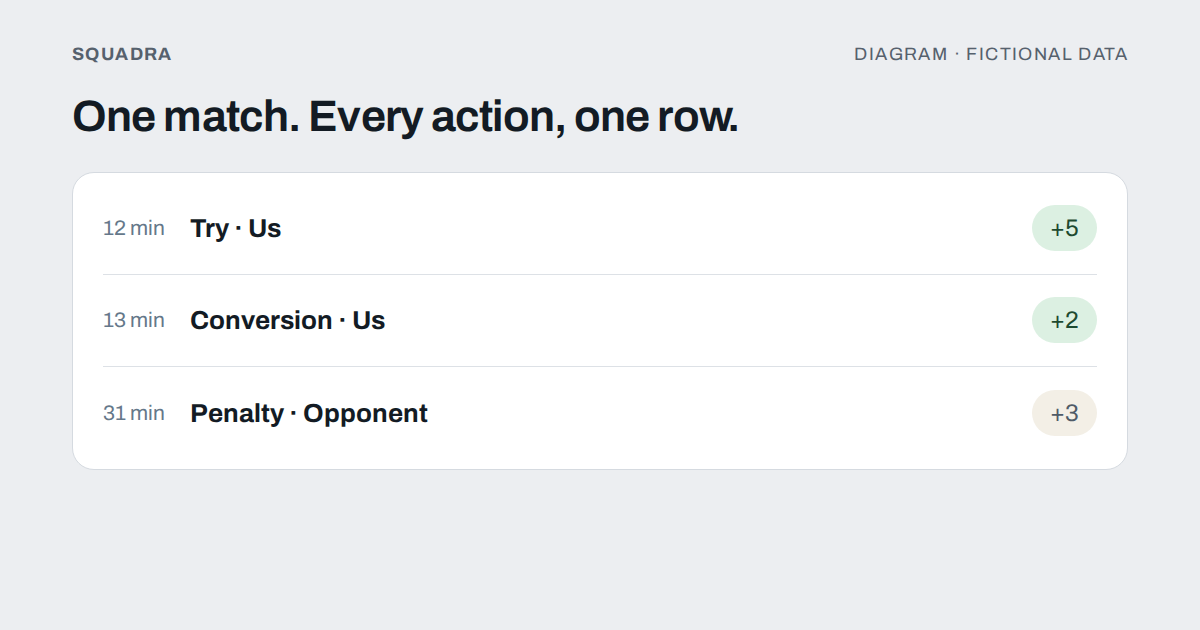
An amateur match produces information that vanishes the moment it ends: who scored, in which minute, who came on for whom, whether there were cards. The next day there are three versions of the result and none of the minute when the lock got injured.
Recording the match while it is played fixes that, and lets anyone who could not make it follow along. This guide explains how to organise it on paper, in a spreadsheet or in an app, what is worth logging, what to do when signal fails and how to correct a mistake without wrecking the record. At the end it explains how Squadra does it.
One person, one job
The first decision is who keeps the record, and the right answer is someone with no other task. The head coach is reading the game and the substitutions; the team manager, who usually handles logistics, is the natural candidate. What does not work is splitting the record between three people who each watch a different side.
Also name a stand-in in advance. If the team manager runs out of battery or has to talk to a referee, someone should be able to take over without starting from scratch.
What to log and what to leave
The finer the record, the fewer people keep it up until the end. A reasonable ladder:
- The essentials: scoring actions. Who, when and how many points. That is enough to rebuild the score.
- The useful: cards, substitutions and injuries. They change the match and get argued about afterwards.
- The optional: fine-grained statistics. Tackles, carries, turnovers or receptions only if someone is free to log them. Without that person, half-logging is worse than not logging.
Decide your club’s level before the season, not on the touchline.
Points in each sport
Logging with a generic counter forces you to add up in your head. If the record knows the actions of the sport, the score calculates itself:
- Rugby union: try, 5 points; conversion, 2; penalty, 3; and drop goal, 3. Yellow and red cards do not score but are part of the record.
- American football: touchdown, 6 points; extra point, 1; two-point conversion, 2; field goal, 3; and safety, 2.
Attributing the action to a person later lets you produce the season’s top scorers table.
The line-up comes from the call-up
The record starts before the ball is kicked. If the match is already in the calendar and players have confirmed, it makes sense for the line-up to be built from those who said yes, with their shirt number and position, instead of typing it out again.
Two precautions:
- Check shirt numbers and positions before kick-off. A repeated number or an empty position in the line-up carries into every statistic afterwards.
- If two people edit the line-up at once, someone should flag the clash instead of silently overwriting each other’s changes.
The clock and the signal
Two technical problems that ruin more match records than any arithmetic slip.
The clock. If the stopwatch lives in the scorer’s phone, a call, a reload or a battery at ten per cent throws every minute off. A clock that is counted somewhere other than the phone survives that. In exchange, starting or stopping it needs a connection.
The signal. Some pitches give you one bar. The sensible behaviour is that logging an action with no signal is not lost but queued, and goes up when coverage returns. The catch: what is queued cannot be undone until it arrives, and anyone following from home will not see it until then.
Correcting without breaking the record
You log standing up, in a hurry, with your eyes on the pitch, so the wrong tap is the most common mistake. A good system gives three ways out, from simplest to most serious:
- Immediate undo. A short window after logging to retract exactly that action. Better if it only works for the latest one, because two stacked notices invite deleting the wrong one.
- Deleting an event from the timeline, with confirmation, when the mistake is found later.
- Reopening a closed record. A finished match is closed, and to touch it you have to reopen it on purpose. It is a deliberate nuisance: it stops a figure changing through a stray tap.
And a house rule: what is corrected is corrected in the record, not in a separate message.
Who can record and who can watch
Once the match becomes something shared, the usual question returns: who sees what?
- Records whoever runs the match: in Squadra, the team manager, the Head Coach and anyone granted that permission. Each Head Coach runs the matches of their own category; those of other categories are read-only for them.
- Follows the match the whole team. Supporters see the live score and the scoring actions and nothing else: the line-up and the actions that do not score (substitutions, injuries, cards, fine statistics) stay inside the club. With minors, that boundary matters.
For visibility of data in general, see who sees what in a club app.
How Squadra does it
This is what the app does today:
- The match is created from the call-up, and the line-up arrives with the confirmed players, their shirt number and their position. You can also create a standalone match, and then it asks which category it belongs to.
- Actions are those of the sport (the ones above, plus substitutions and injuries and, if you want, tackles and so on), logged for us or for the opponent, and attributed to a player when there is one: who did it, or who comes off and who goes on.
- A clock by periods: start, pause, resume, next period and finish. The server counts the clock, not the phone, which is why it needs a connection to start or stop. It warns you when a period runs past its length, and it does not let you log anything until the match has started.
- Logging without signal queues the action and sends it when the signal returns.
- Six seconds to undo the latest entry, deleting an event from the timeline with confirmation, and reopening a closed record to correct it.
- Two people can record at the same time, and if someone changes the line-up meanwhile, the app tells you instead of overwriting it.
- Live scoreboard for anyone following the match, and a club top scorers table.
- Shareable line-up image, in rugby: an image with starters and bench that warns you if a shirt number or position is missing, or if the starters are not fifteen. For American football, it does not exist today.
What it does not do: it does not infer actions by itself or replace the person keeping the record. It is a better place to write things down, not a referee.
The honest test
On Monday, without asking anyone: can you say who scored, in which minute, and who the injured player was replaced by? If you need three chats to answer, the match record does not exist, even if the result has been published.
The best record is not the most detailed one: it is the one that gets done completely, every time, however short. Start with the scoring actions and add the rest once that works.
To see how it works in each sport, there are the pages for rugby and American football.