
Wellness and medical
Knowing who turns up in bad shape before they break
Injuries rarely show up all at once: they show up after three bad nights of sleep and a week of heavy legs. Measuring it is the easy part; getting someone to look in time is not, and getting what you measure to stay comparable from one week to the next is the other half.
One minute a day, and done
Players rate eight things from 1 to 5 on their phone, on the way to training. If they want, they add hours of sleep, resting heart rate and where it hurts. If it takes more than a minute, by week three nobody fills it in, so it is built to be done standing up in the changing room.
- Sleep, fatigue, soreness, stress, mood, recovery, energy and specific pain
- Big buttons, made to fill in one-handed
- Everyone sees their own history; other diaries aren’t theirs
- Players see what they answered, not the score that comes out of it
- Anyone in two clubs keeps a separate diary in each, with nothing mixed
- The day’s entry can be deleted and filled in again
The alert comes to you
Staff don’t have to read twenty diaries: the alert fires when someone goes red, strings three bad days together, reports sharp pain or stops filling it in.
- The panel sorts by severity: worst first
- Thresholds set per category, because a colt isn’t a senior
- A category with none of its own inherits the club’s
- Resolving one alert doesn’t mute the next one for that player
- One tap from the alert to that person’s profile
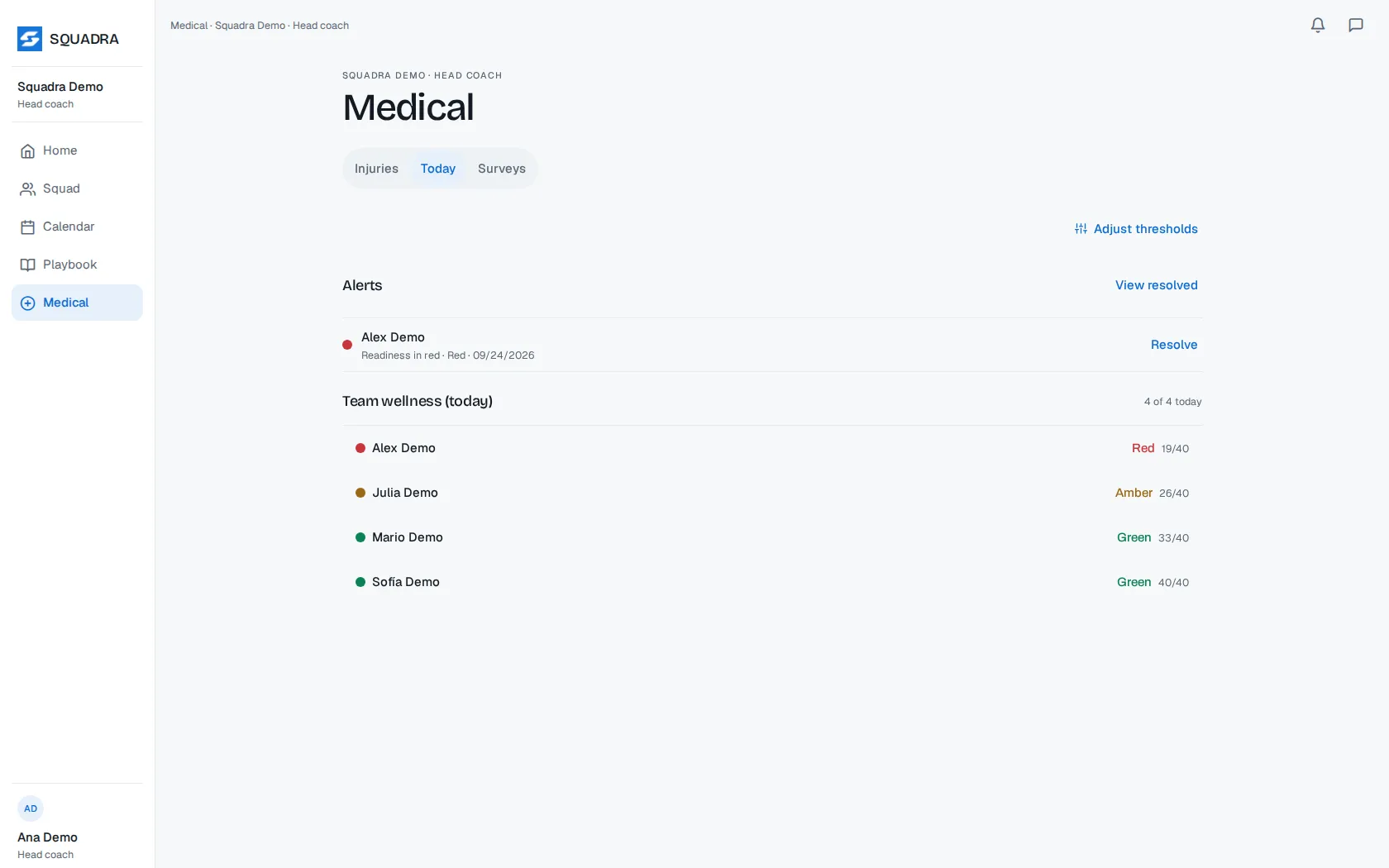
And what was done about it stays written down
Closing an alert means saying why, and it isn’t a free-text box nobody fills in: the database won’t let it close without a reason. Three months later you can go back and see who closed it, when, and what they decided.
- Talked to the player, load reduced, rest, referred to a doctor, no change, or false positive
- Ninety days of history you can actually read, not a column nobody queries
- Enough to settle whether that niggle in February was treated or waved through
- Reading someone else’s clinical data leaves a trace of who looked
Specific permissions for health data
Injuries and diagnoses are managed separately. Squadra uses specific permissions for access to clinical information and checks them in the database.
- A specific capability for reading diagnoses
- Category scopes in coaching staff memberships
- Minors carry a registered guardian and consent
- Consent checks when recording clinical data
- Availability calendar with permissions for each type of access
The injury and the diagnosis are two different things
A coach needs to know whether they can count on someone on Saturday. They don’t need to know what the surgery was for. Two different questions, and in Squadra they live in two different places.
- Pitch-side traffic light: green, amber with or without contact, and red
- Area, mechanism, date and expected return, so the week can be planned
- Diagnosis, treatment and clinical notes, in a separate table behind its own permission
- Player records separate from diagnosis and treatment
The physio table has a diary too
The physio opens up the week’s slots and each player takes one from their phone, without the usual chain of messages to pin down a time. The availability calendar and clinical information have different functions and permissions.
- Slots published by the physio and booked by the player
- Separate physiotherapy and appointment booking functions
- Bookings linked to the person requesting the slot
- It links to the injury, so the record and the table are talking about the same case
A minute a day for eight months is real data
Two weeks of diaries show a trend. A full season shows who always turns up flat for the game after a long away trip, and that stops being the coach’s hunch.
- One diary per person per day, with no duplicates skewing the average
- Hours of sleep, resting heart rate and pain location, if you want them
- Weight is recorded where it belongs and not shown to whoever shouldn’t see it
- Every player can read their own history whenever they want
Start measuring as soon as it opens
An alert can fire the first day someone fills the diary in; the trend takes a couple of weeks. We will let you know when you can use it with your squad.
Notify me at launch