
Building a digital playbook in an amateur team
The hard part of a playbook is not drawing it. It is getting it to land, getting it understood, and knowing who has opened it before Saturday.
· updated on
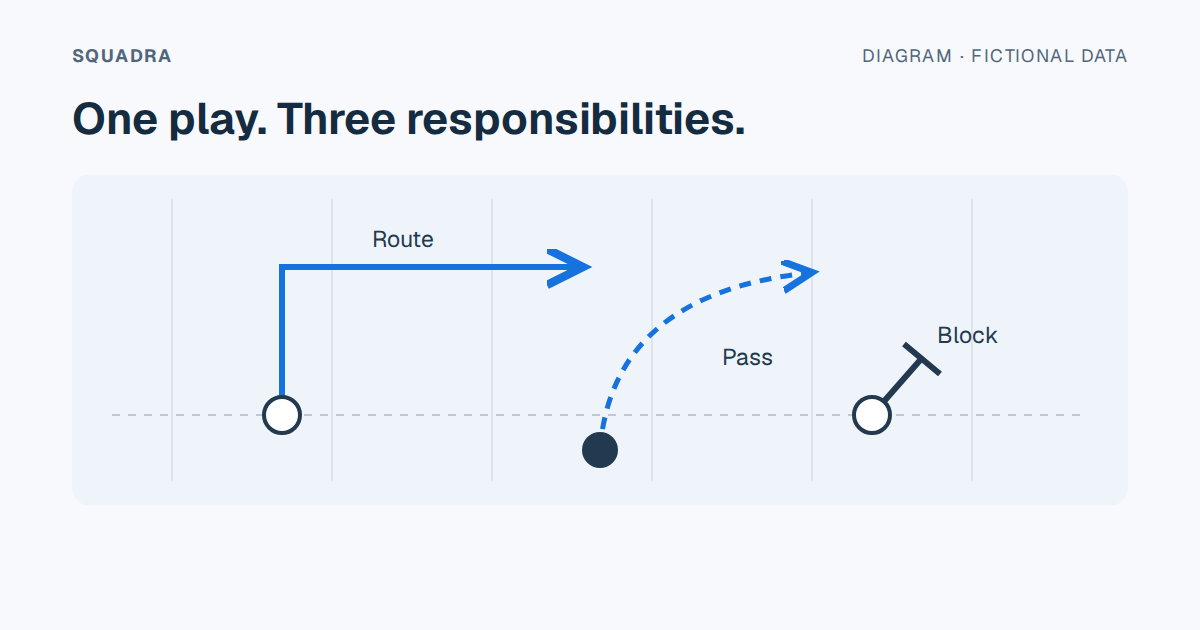
Nearly every amateur football team goes through the same three stages: plays in the coordinator’s notebook, plays photocopied for whoever remembers to pick them up, and plays photographed and dropped into a group chat where four days later they sit under a meme.
None of the three fails at drawing. They fail at distribution.
What a playbook has to solve, in order
1. It has to make sense without you standing there. A diagram with twenty-two marks and eight arrows is legible to whoever drew it. To a second-year rookie, on a bus, on a phone, it isn’t. If the play has development, watching it move beats any key or legend.
2. It has to reach the right people. The whole playbook doesn’t need to be a state secret, but the juniors shouldn’t be digging through the senior side’s hundred and twenty plays to find their five.
3. You have to know whether it landed. This is the one almost nobody has. With no signal at all about who opened it, on Wednesday at practice you find out half the squad never looked, and by then there’s no time.
4. It has to change without reprinting. You tweak a protection on Thursday. If the squad is holding last week’s photocopy, that change doesn’t exist.
How it gets organised in practice
What works in amateur teams isn’t the perfect taxonomy, it’s the one somebody maintains:
- Unit first (offense, defense, special teams), formation second. That’s how you practise, so that’s how you search.
- Short, shoutable names. If the name doesn’t fit in a shout from the sideline, the name is wrong.
- One play, one screen. If you have to scroll to see the full development, half of it is lost.
- Mark who it’s for. Even if the system doesn’t filter by position, writing «this one is O-line» saves everybody time.
Diagrams, animation and video: what you actually need
There’s a ladder of cost and usefulness, and most teams skip the first rung trying to reach the third:
- Static diagram. Cheap, and enough for formations and assignments.
- Frame-by-frame animation. You place the tokens at the start, at the middle and at the end, and the player interpolates. This is what turns «I don’t get my route» into «ah, right». Barely more expensive than static, and far more useful.
- Video of the real play. What everybody wants and the genuinely expensive one: film, clip, upload, store. In an amateur team, start with the first two.
The costly mistake: confusing «I shared it» with «they know it»
Sharing is something you do. Learning the play is something they do. Between the two there’s a gap, and the only thing that closes it is some way of knowing who has opened it.
You don’t need an analytics dashboard: knowing that eight of the forty have opened it already changes your Thursday decision. If it’s eight, you’re not calling it on Saturday.
And a rule that saves arguments
One person maintains the playbook. Two coordinators uploading different versions of the same play produce exactly the same chaos as photocopies, with more steps and more screens.
If the team is big enough to have two coordinators, then each keeps their own unit and neither touches the other’s.